library(torch)
library(luz)
library(tidyverse)
library(tidymodels)
library(MLDataR)
library(innsight)3 Tutorial 3: Deep neural network with explainable method (binary classification)
Aims: To predict heart disease using a deep neural network - To explain model predictions using Layer-wise Relevance Propagation (LRP) - To visualize feature importance at both individual and global levels
Data: heartdisease data from MLDataR package.
Code description: This code demonstrates the use of torch with custom dataset functions, training callbacks, and model explainability using the innsight package for binary classification with LRP.
Packages
Data
heart_df <-
  heartdisease %>%
  mutate(across(c(Sex, RestingECG, Angina), as.factor))
Explore data.
skimr::skim(heart_df)| Name | heart_df |
| Number of rows | 918 |
| Number of columns | 10 |
| _______________________ | |
| Column type frequency: | |
| factor | 3 |
| numeric | 7 |
| ________________________ | |
| Group variables | None |
Variable type: factor
| skim_variable | n_missing | complete_rate | ordered | n_unique | top_counts |
|---|---|---|---|---|---|
| Sex | 0 | 1 | FALSE | 2 | M: 725, F: 193 |
| RestingECG | 0 | 1 | FALSE | 3 | Nor: 552, LVH: 188, ST: 178 |
| Angina | 0 | 1 | FALSE | 2 | N: 547, Y: 371 |
Variable type: numeric
| skim_variable | n_missing | complete_rate | mean | sd | p0 | p25 | p50 | p75 | p100 | hist |
|---|---|---|---|---|---|---|---|---|---|---|
| Age | 0 | 1 | 53.51 | 9.43 | 28.0 | 47.00 | 54.0 | 60.0 | 77.0 | ▁▅▇▆▁ |
| RestingBP | 0 | 1 | 132.40 | 18.51 | 0.0 | 120.00 | 130.0 | 140.0 | 200.0 | ▁▁▃▇▁ |
| Cholesterol | 0 | 1 | 198.80 | 109.38 | 0.0 | 173.25 | 223.0 | 267.0 | 603.0 | ▃▇▇▁▁ |
| FastingBS | 0 | 1 | 0.23 | 0.42 | 0.0 | 0.00 | 0.0 | 0.0 | 1.0 | ▇▁▁▁▂ |
| MaxHR | 0 | 1 | 136.81 | 25.46 | 60.0 | 120.00 | 138.0 | 156.0 | 202.0 | ▁▃▇▆▂ |
| HeartPeakReading | 0 | 1 | 0.89 | 1.07 | -2.6 | 0.00 | 0.6 | 1.5 | 6.2 | ▁▇▆▁▁ |
| HeartDisease | 0 | 1 | 0.55 | 0.50 | 0.0 | 0.00 | 1.0 | 1.0 | 1.0 | ▆▁▁▁▇ |
Dataset function
heart_dataset <- dataset(
  initialize = function(df) {
    # Pre-process and store as tensors
    self$x_num <- df %>%
      select(Age, RestingBP, Cholesterol, FastingBS, MaxHR, HeartPeakReading) %>%
      mutate(across(everything(), scale)) %>%
      as.matrix() %>%
      torch_tensor(dtype = torch_float())

    self$x_cat <- model.matrix(~ Sex + RestingECG + Angina, data = df)[, -1] %>%
      as.matrix() %>%
      torch_tensor(dtype = torch_float())

    self$y <- torch_tensor(as.matrix(df$HeartDisease), dtype = torch_float())
  },
  .getitem = function(i) {
    list(x = list(self$x_num[i, ], self$x_cat[i, ]), y = self$y[i])
  },
  .length = function() {
    self$y$size(1)
  }
)

# Convert to torch dataset
ds_tensor <- heart_dataset(heart_df)
ds_tensor[1]
$x
$x[[1]]
torch_tensor
-1.4324
0.4107
0.8246
-0.5510
1.3822
-0.8320
[ CPUFloatType{6} ]
$x[[2]]
torch_tensor
1
1
0
0
[ CPUFloatType{4} ]
$y
torch_tensor
0
[ CPUFloatType{1} ]Split data with dataset subsets
set.seed(123)
n <- nrow(heart_df)
train_size <- floor(0.6 * n)
valid_size <- floor(0.2 * n)

# Create indices
all_indices <- 1:n
train_indices <- sample(all_indices, size = train_size)

remaining_indices <- setdiff(all_indices, train_indices)
valid_indices <- sample(remaining_indices, size = valid_size)

test_indices <- setdiff(remaining_indices, valid_indices)

# Create Subsets
train_ds <- dataset_subset(ds_tensor, train_indices)
valid_ds <- dataset_subset(ds_tensor, valid_indices)
test_ds  <- dataset_subset(ds_tensor, test_indices)
Convert to dataloader
train_dl <- train_ds %>%
  dataloader(batch_size = 10, shuffle = TRUE)

valid_dl <- valid_ds %>%
  dataloader(batch_size = 10, shuffle = FALSE)

test_dl <- test_ds %>%
  dataloader(batch_size = 10, shuffle = FALSE)
Specify the model
net <-
  nn_module(
    initialize = function(d_in){
      self$net <- nn_sequential(
        nn_linear(d_in, 32),
        nn_relu(),
        nn_dropout(0.5),
        nn_linear(32, 64),
        nn_relu(),
        nn_dropout(0.5),
        nn_linear(64, 1),
        nn_sigmoid()
      )
    },
    forward = function(x){
      # x is currently a list of two tensors (numeric and categorical)
      # Concatenate them along the feature dimension (dim=2)
      input <- torch_cat(x, dim = 2)
      self$net(input)
    }
  )
Fit the model
Set parameters
d_in <- length(ds_tensor[1]$x[[1]]) + length(ds_tensor[1]$x[[2]]) # total number of features (6 numeric + 4 categorical = 10)Fit with callbacks
fitted <-
  net %>%
  setup(
    loss = nn_bce_loss(),
    optimizer = optim_adam,
    metrics = list(
      luz_metric_binary_accuracy(),
      luz_metric_binary_auroc()
    )
  ) %>%
  set_hparams(d_in = d_in) %>%
  fit(
    train_dl,
    epoch = 50,
    valid_data = valid_dl,
    callbacks = list(
      luz_callback_early_stopping(patience = 10),
      luz_callback_keep_best_model()
    )
  )
Training plot
fitted %>% plot()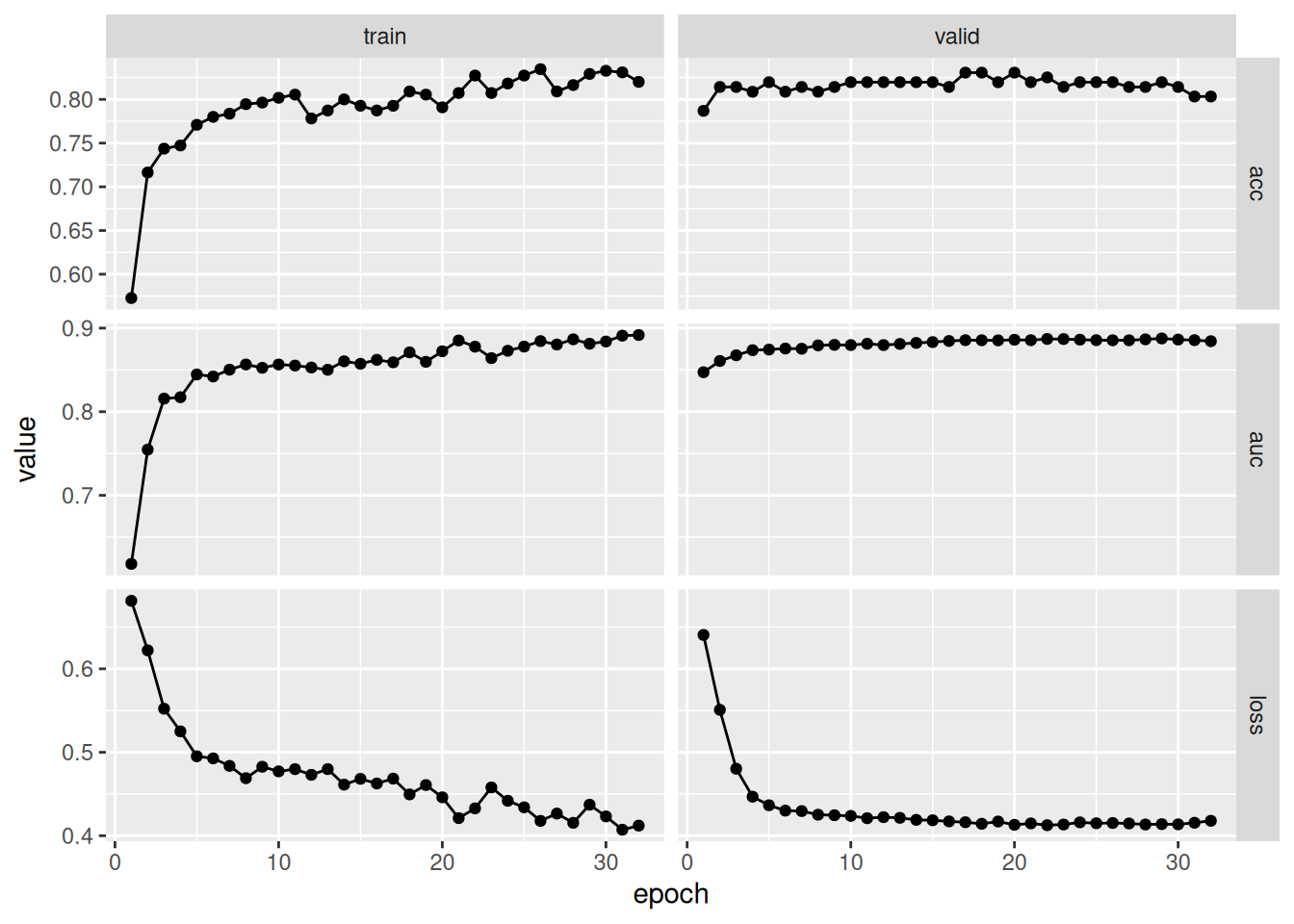
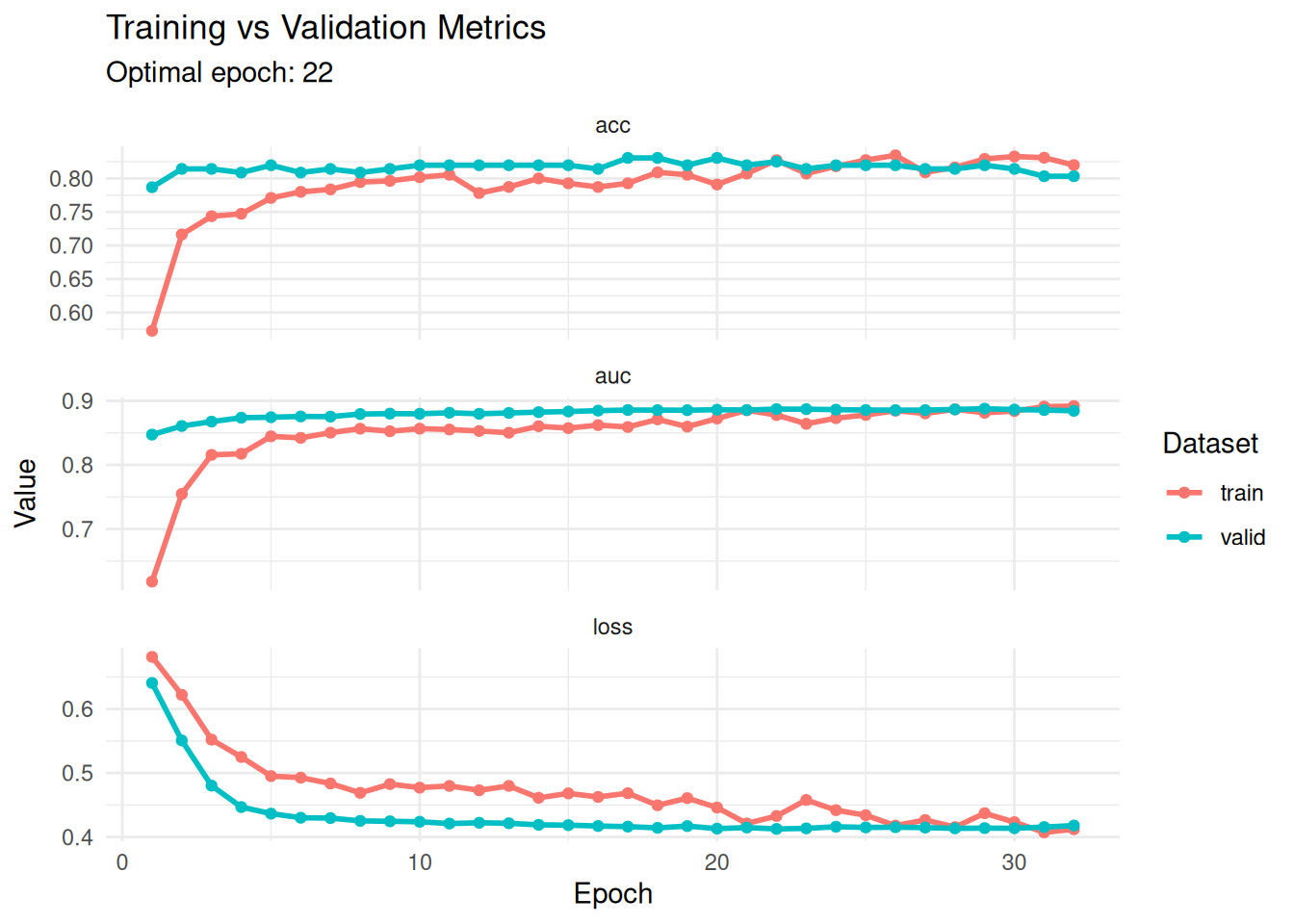
Better plot
hist <- get_metrics(fitted)

optimal_epoch <- hist %>%
  filter(metric == "loss", set == "valid") %>%
  slice_min(value, n = 1) %>%
  pull(epoch)

hist %>%
  ggplot(aes(x = epoch, y = value, color = set)) +
  geom_line(linewidth = 1) +
  geom_point(size = 1.5) +
  facet_wrap(~ metric, scales = "free_y", ncol = 1) +
  theme_minimal() +
  labs(
    title = "Training vs Validation Metrics",
    subtitle = paste("Optimal epoch:", optimal_epoch),
    y = "Value",
    x = "Epoch",
    color = "Dataset"
  )
Predict testing set
y_pred <- fitted %>% predict(test_dl)
y_true <- ds_tensor$y[test_ds$indices] %>% as_array()

dat_pred <-
  y_pred %>%
  as_array() %>%
  as_data_frame() %>%
  rename(prob = V1) %>%
  mutate(
    pred = factor(ifelse(prob > 0.5, 1, 0)),
    true = factor(y_true)
  )
Warning: `as_data_frame()` was deprecated in tibble 2.0.0.
ℹ Please use `as_tibble()` (with slightly different semantics) to convert to a
tibble, or `as.data.frame()` to convert to a data frame.Warning: The `x` argument of `as_tibble.matrix()` must have unique column names if
`.name_repair` is omitted as of tibble 2.0.0.
ℹ Using compatibility `.name_repair`.
ℹ The deprecated feature was likely used in the tibble package.
Please report the issue at <https://github.com/tidyverse/tibble/issues>.dat_pred# A tibble: 185 × 3
prob pred true
<dbl> <fct> <fct>
1 0.0886 0 0
2 0.326 0 0
3 0.0819 0 0
4 0.957 1 1
5 0.0911 0 0
6 0.182 0 0
7 0.311 0 0
8 0.383 0 0
9 0.871 1 0
10 0.102 0 1
# ℹ 175 more rowsEvaluate
fitted %>% evaluate(test_dl)A `luz_module_evaluation`
── Results ─────────────────────────────────────────────────────────────────────
loss: 0.4137
acc: 0.8216
auc: 0.8852Confusion matrix
dat_pred %>%
  conf_mat(true, pred) %>%
  autoplot("heatmap")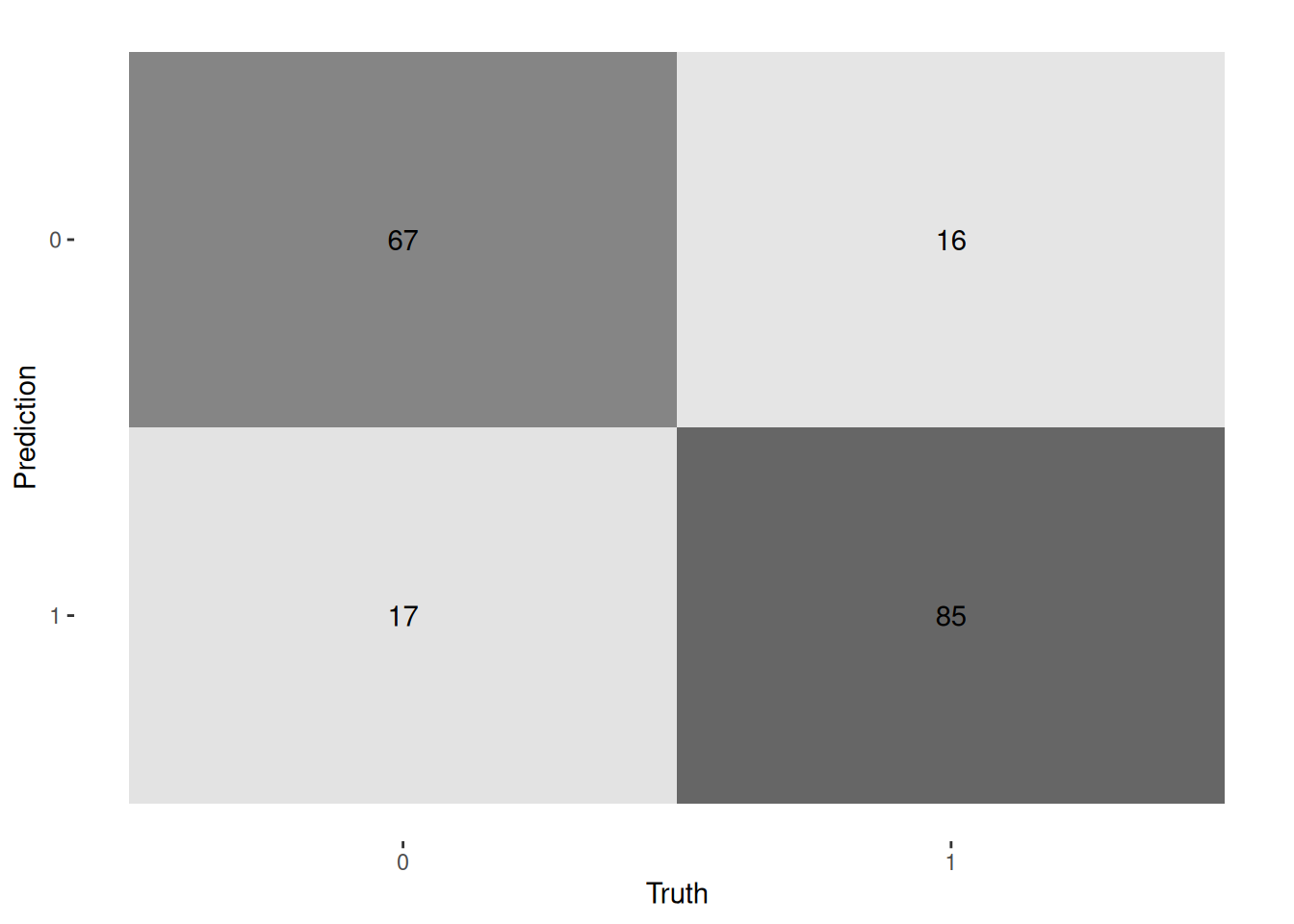
Accuracy
dat_pred %>%
  accuracy(truth = true, estimate = pred)
# A tibble: 1 × 3
.metric .estimator .estimate
<chr> <chr> <dbl>
1 accuracy binary 0.822Plot ROC
dat_pred %>%
  roc_curve(true, prob, event_level = "second") %>%
  autoplot()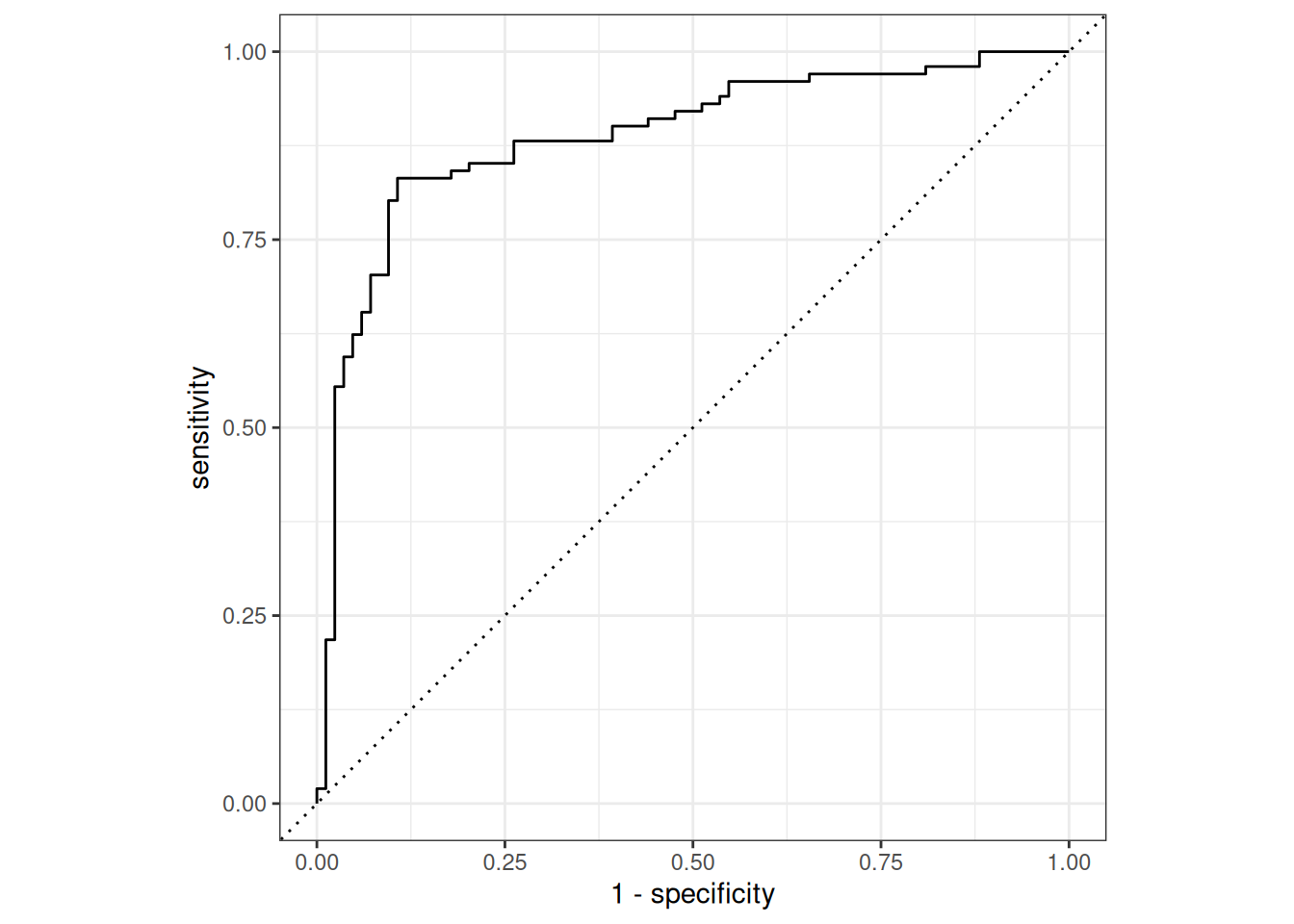
# ROC-AUC
dat_pred %>%
  roc_auc(true, prob, event_level = "second")
# A tibble: 1 × 3
.metric .estimator .estimate
<chr> <chr> <dbl>
1 roc_auc binary 0.887Model explainability with LRP
Prepare model for interpretation.
# Extract the sequential model
model <- fitted$model$net$cpu()

# Define input and output names
input_names <- c(
  # Numeric variables
  "Age", "RestingBP", "Cholesterol", "FastingBS", "MaxHR", "HeartPeakReading",
  # Categorical dummies (from model.matrix ~ .-1)
  "Sex_M", "RestingECG_Normal", "RestingECG_ST", "Angina_Y"
)

output_names <- c("Probability of heart disease")
Create converter and prepare test data.
# Create the Converter object
converter <- convert(
  model,
  input_dim = 10,
  input_names = input_names,
  output_names = output_names
)
Skipping nn_dropout ...
Skipping nn_dropout ...# Manually extract and concatenate the test data
idxs <- test_ds$indices
x_num <- ds_tensor$x_num[idxs, ]
x_cat <- ds_tensor$x_cat[idxs, ]
# Combine into one tensor and convert to R array
input_tensor <- torch_cat(list(x_num, x_cat), dim = 2)
input_data <- as_array(input_tensor)Apply Layer-wise Relevance Propagation (LRP).
# Run LRP with alpha-beta rule
lrp_result <- run_lrp(converter, input_data, rule_name = "alpha_beta", rule_param = 1)

# Check dimensions: Instances x Features x Outputs
dim(get_result(lrp_result))
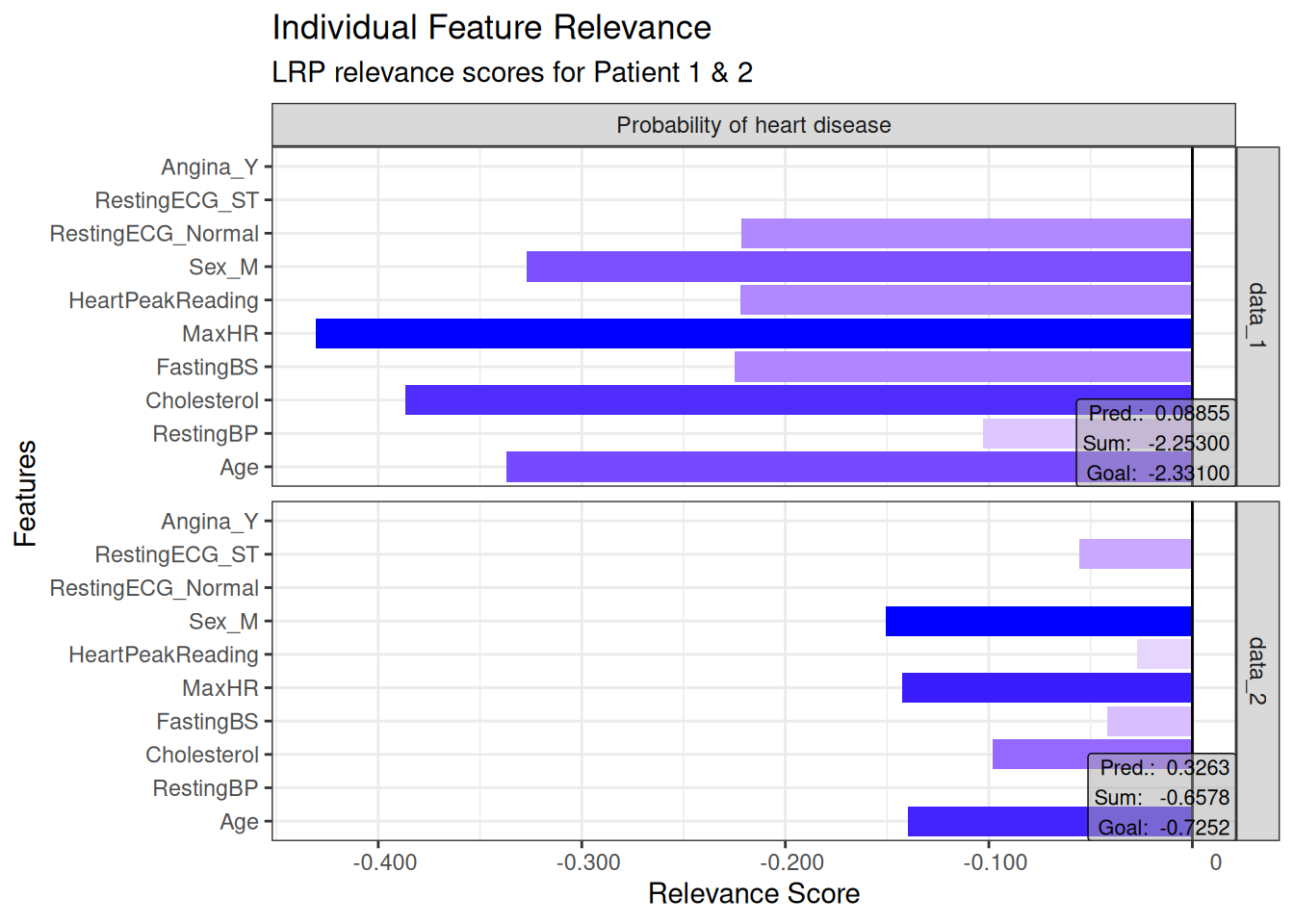
[1] 185 10 1Individual explanations.
# Individual plots for the first two test instances
plot(lrp_result, data_idx = c(1, 2)) +
  theme_bw() +
  coord_flip() +
  labs(
    title = "Individual Feature Relevance",
    subtitle = "LRP relevance scores for Patient 1 & 2",
    x = "Features",
    y = "Relevance Score"
  )
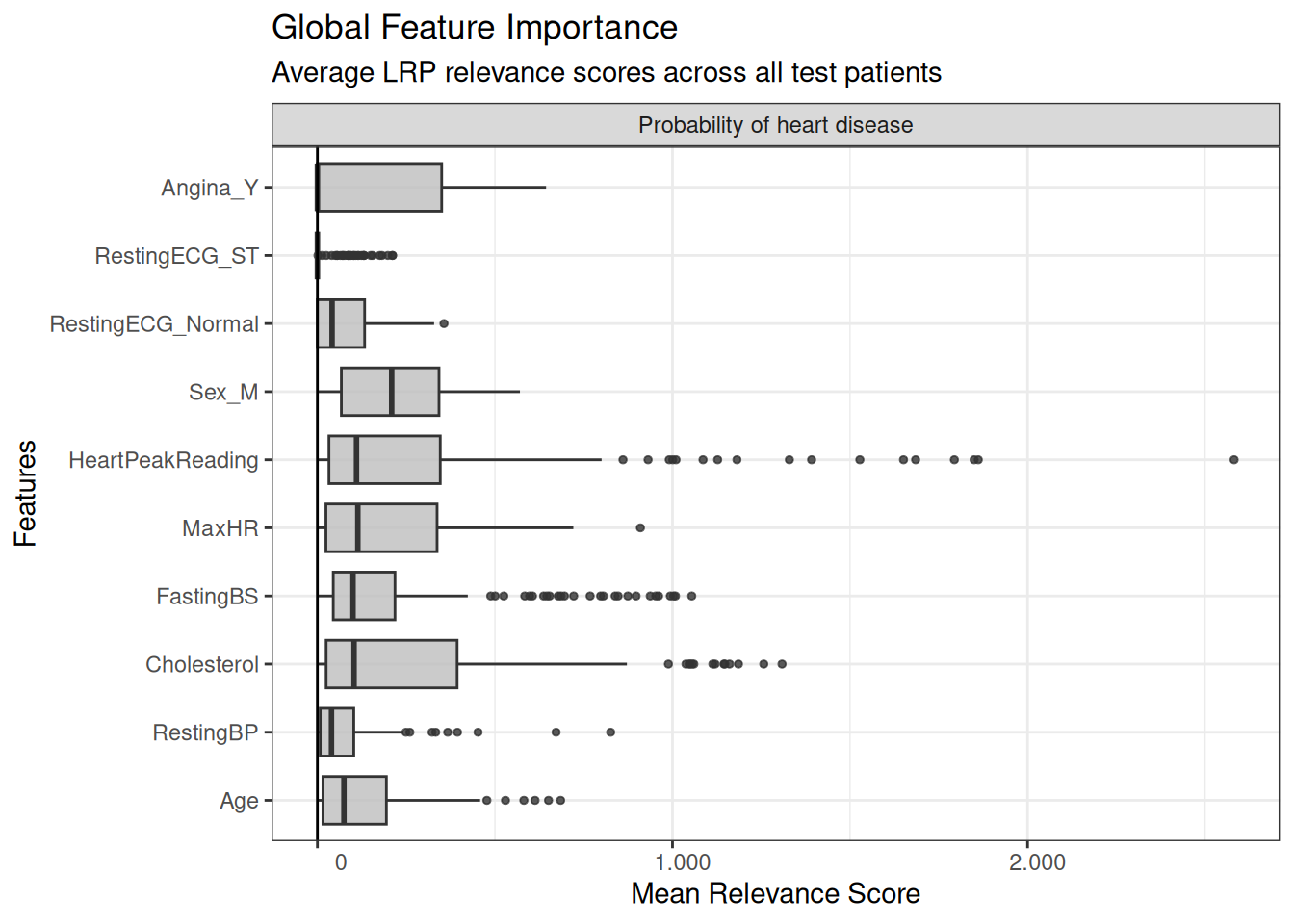
Global explanations.
# Global boxplot - overall feature importance across the entire test set
boxplot(lrp_result) +
  theme_bw() +
  coord_flip() +
  labs(
    title = "Global Feature Importance",
    subtitle = "Average LRP relevance scores across all test patients",
    x = "Features",
    y = "Mean Relevance Score"
  )
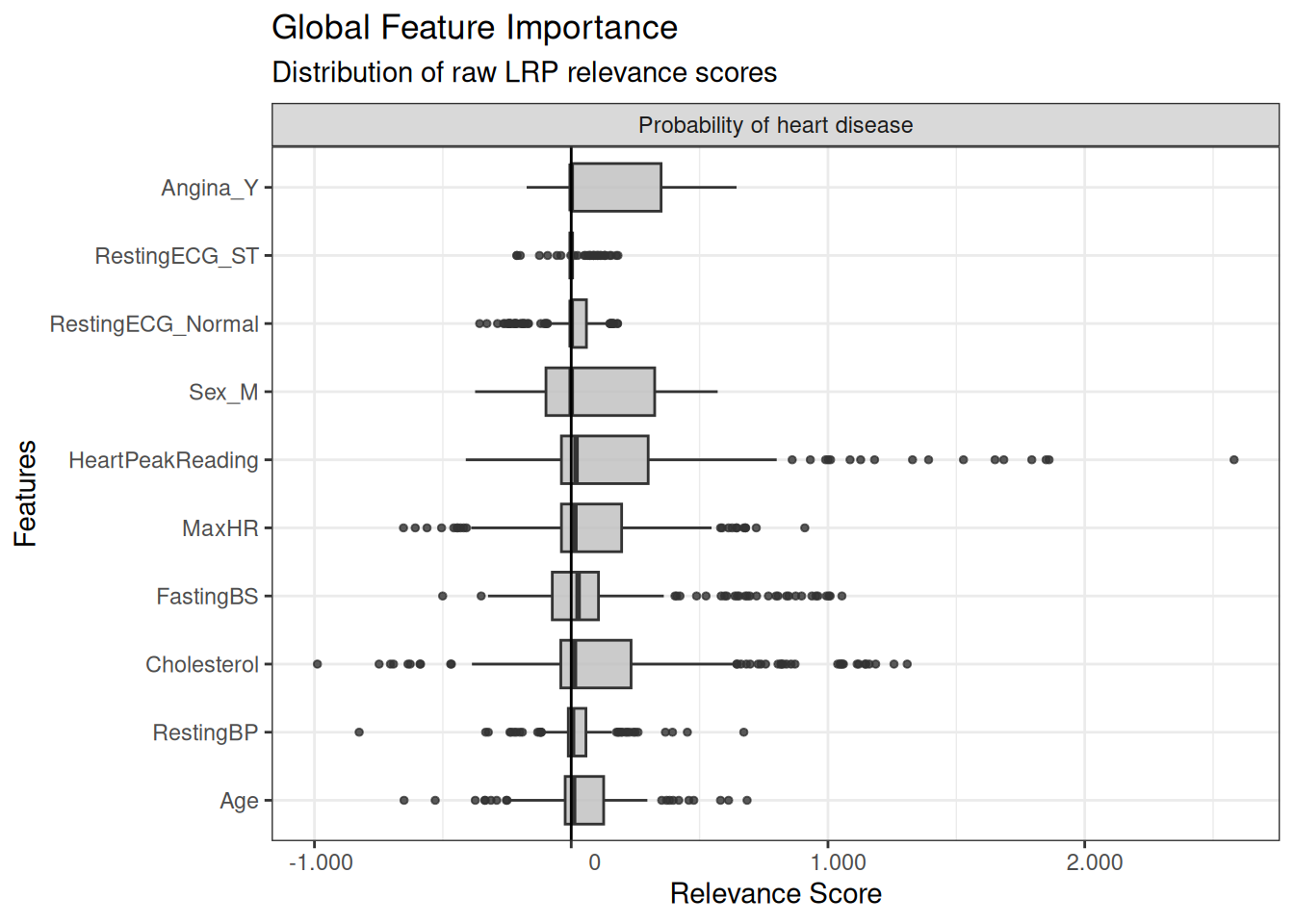
Global explanation with raw relevance scores.
# Another version of global boxplot with identity transformation
boxplot(lrp_result, preprocess_FUN = identity) +
  theme_bw() +
  coord_flip() +
  labs(
    title = "Global Feature Importance",
    subtitle = "Distribution of raw LRP relevance scores",
    x = "Features",
    y = "Relevance Score"
  )